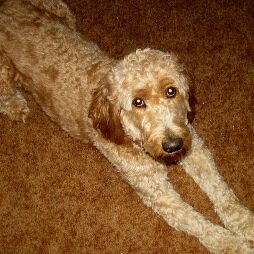
Designer (or hybrid) dogs carry a lot of stigma — terms like “puppy mill” often get attached in an effort to discredit legitimate cross-breed breeders. It’s worth asking: do purebred breeders always know where their own breed came from? Golden Retrievers, for instance, originated as a mix of Water Spaniel, Retriever, Irish Setter, Bloodhound, and St. John’s Water Dog. If that’s not a “mutt,” what is? Every breed starts the same way — intentional breeders selecting for desired traits, generation after generation, until those traits reliably reproduce.
Hybrid vigor
What breeders of hybrid dogs have found is that the most desirable traits often show up from the very first generation. There can be real variation — size, coat type, degree of hypoallergenic quality — but temperament and health are consistently improved over both parent lines. That effect is called hybrid vigor.
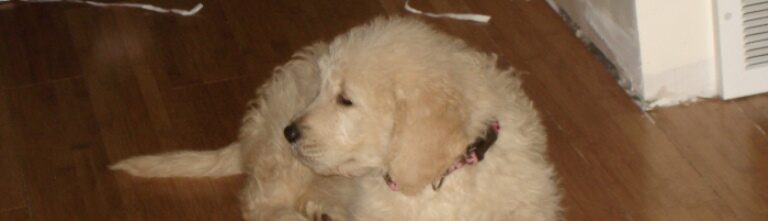
Decoding the F1, F1b, F2 labels
- F1 — First generation: a purebred mother and father from two different breeds.
- F1b — First generation backcross: one parent is an F1, the other a purebred from one of the original breeds.
- F2 — Second generation: both parents are F1s.
- F2b — Second generation backcross: one parent is an F2, the other further up the line (an F1 or a purebred).
Beyond that, you’ll often see breeders simply use “multigen” for anything further along (F3, F4, and beyond) — short for multi-generational. There are two general approaches among designer-dog breeders: breeding “the true hybrid” each generation, or working toward a stabilized “new breed” by pairing two cross-bred dogs of the same mix together (these puppies are the multigens).
Many designer breeds are built around crossing with a Poodle specifically, since Poodles carry hypoallergenic qualities that let a large share of allergy sufferers be around them comfortably — likely a big part of why there are so many Poodle-cross designer breeds today. (As with any dog, no breed is guaranteed allergen-free for every single person — that’s not what hypoallergenic claims to mean; see our Hypoallergenic Dogs page for more.)
Finding their role
A successful cross-breed needs two things: reliably reproducible desirable traits, and real demand from the public. Every successful breed in history has found its role in human life — service, hunting, ranching, companionship, protection. As excellent service dogs, companions, and family pets, designer dogs have genuinely earned a starring role of their own across North America. The term itself has only existed for a couple of decades — it simply describes intentionally breeding two purebred dogs of different breeds for a desired result, which is really just another word for hybrid dog. (Your dog and the neighbor’s dog getting together, on the other hand, still just makes a mutt.)