
Choosing a puppy well starts long before you pick one out — it starts with how the litter itself was raised and matched to families. Here’s what we looked for and practiced in our own breeding program, and what we’d encourage anyone to look for in a responsible breeder today.
Bred for family life, not for work
Some breeds are bred to be working dogs — security, service, hunting. Goldendoodles are bred to be pets. The criteria a good breeder looks for in puppies and their prospective homes should be about matching personality and temperament for a great family pet, especially where children are involved.
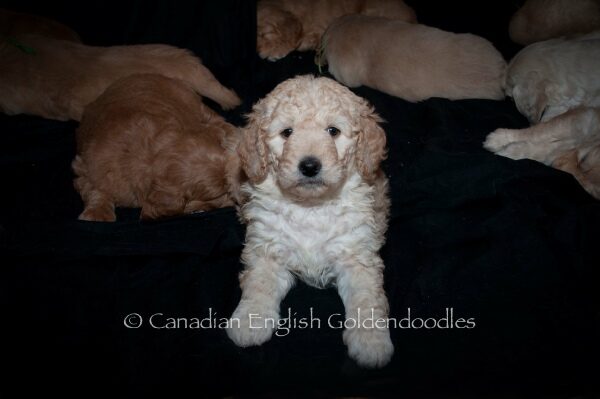
What about families who want to choose their own puppy?
A family’s preferences matter and should be taken into account — color, gender, and coat type (especially where allergies are a concern). But a responsible breeder is also weighing a responsibility to each puppy: ensuring it goes to the home best suited for it, not simply the first family that asks. Breeders who back their puppies with real guarantees — an initial adjustment period, a multi-year health guarantee, ongoing support as the family raises the dog — are, in our experience, also the ones taking selection seriously in the first place; it’s hard to support a family long-term in a placement you didn’t help get right.
Flexibility on the family’s side matters too. Think honestly about what kind of dog fits your lifestyle, and share as much of that as you can with the breeder — the more you communicate, the better the match.
What is temperament testing?
Temperament testing is a tool used by many kennels (and some home breeders) to quantify a puppy’s character traits, typically around seven weeks of age — a set of simple tests gauging things like submissiveness, aggression, and sensitivity. In a kennel setting with too many puppies to spend hours individually with each one, it’s a practical way to gather results to pass on to new owners.
Some breeds benefit from this testing more than others, since different breeds carry different inherent temperament ranges — some naturally more dominant, others more submissive and loyal. Goldendoodles are a fairly consistent breed on this front: unlike breeds with wide temperament variance, the range between individual Goldendoodle puppies tends to be narrow. On a loyalty scale of 1 to 10, most every puppy falls between 1 and 4. Aggressiveness essentially doesn’t factor in for this breed — what little you might see in an occasional puppy usually traces back to poor parent selection rather than the breed itself.
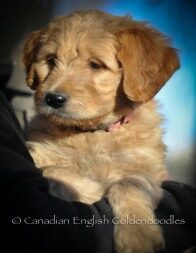
Simple or thorough — it’s your choice
Choosing a puppy can be as simple or as involved as you want it to be. On one end, a family visits a litter, picks whichever puppy looks cutest or that the kids like best, and leaves within the hour. On the other end, a committed breeder invests real hours matching puppies and families — working from both directions to find the best possible fit. Neither approach is wrong, but the second is far more likely to produce a dog that fits your family for the long run.
The traits we actually looked at
We spent hundreds of hours with our puppies starting the day they were born, and by around five weeks we knew each one well. In the meantime, we thought just as hard about the waiting families — their dynamics, lifestyle, and preferences — so the match went both directions. These weren’t in any fixed order of importance; which traits mattered most depended on the specific family and puppy.
- Vocal. Some puppies narrate their whole day; others barely make a sound. A house with a sleeping baby needs a quiet dog; an acreage owner might want one who barks when someone comes down the driveway.
- Strength of character vs. dominance. These are easy to confuse but aren’t the same thing. Dominance is a puppy’s desire to be top dog; strength of character is how hard it will be to establish that the dog is not, in fact, top dog. Counterintuitively, a submissive puppy with a strong character, poorly trained, can become a more dangerous fearful leader than a puppy that actually wants the job — a reluctant leader who doesn’t enjoy the position is prone to fear-biting.
- Energy. A laid-back puppy suits a busy young family happy with yard time and Saturday park trips; a high-energy puppy is a better match for owners who run for hours and hike every weekend.
- Color and coat. Families have their own preferences here, for all kinds of reasons, and coat type matters especially for allergy or shedding concerns.
- Sensitivity. How a puppy responds to touch, noise, and surprise. Goldendoodles as a breed tend to be cheerful and rarely oversensitive, but any puppy that did respond poorly to sensitivity testing was never placed with children.
- Curiosity. Most Goldendoodle puppies are naturally curious; an occasional timid one isn’t a fearful one, but a timid puppy handled poorly can become fearful. Timid puppies went to gentle, patient families who understood that distinction.